What Key Instructional Principles Do Research-validated Reading Interventions Often Include?
How tin Tier three intervention be implemented?
Page 5: Implementing Tier 3 Reading Interventions
 Once students have been identified as needing Tier iii intervention, information technology is time to beginning delivering more than intensive, individualized pedagogy. High quality instruction in Tier 3 covers the core components of reading (i.eastward., phonemic sensation, phonics and word study, reading comprehension, vocabulary, fluency) and should exist research validated. Many research-validated reading interventions are based on key instructional principles:
-
Systematic didactics is that which is carefully planned and sequenced so that its lessons build on one some other, moving from elementary skills and concepts to more complex ones.
-
Explicit or direct instruction involves teaching a specific skill or concept in a highly structured environment using clear, straight language. This type of instruction focuses on producing specific learning outcomes and is sometimes achieved through the use of scripted lessons. During explicit instruction, the teacher clearly identifies the expectations for learning, highlights important details of the concept or skill, provides precise instructions, and connects new learning to previous learned material.
-
Immediate corrective feedback is provided every bit soon every bit possible following the operation of an activeness to inform the student that his or her reply is inaccurate and to correct his or her understanding of the skill or concept at consequence.
-
Frequent review is the practice of revisiting a skill or concept over time to appraise understanding and mastery and to ensure that the skill is maintained.
-
To assist students to maintain their previously mastered skills, teachers should provide students with opportunities to practice them. In addition, immediately after a skill has been taught, teachers should offering students opportunities to practice it in order to build mastery. This can include guided likewise equally contained do.
-
Scaffolded instruction is a process during which a teacher adds instructional supports to enhance a pupil'southward learning and aid in the mastery of a skill, concept, or task.

Action
After reviewing the definitions for the 6 key instructional principles listed in a higher place, watch the video clips below. For each video, select the instructional principle being highlighted.
Activity A
explicit or direct teaching
scaffolded instruction
immediate corrective feedback
opportunities to exercise
(Close this console)
Activity B
explicit or direct instruction
scaffolded instruction
immediate corrective feedback
opportunities to do
(Close this panel)
Activeness C
explicit or straight instruction
scaffolded pedagogy
immediate cosmetic feedback
opportunities to practice
(Close this panel)
"Copyright © by the Texas Didactics Bureau and University of Texas at Austin. All rights reserved" on all Licensed Materials.
A school or district can determine how finer a program covers the five core components and utilizes key instructional principles.
Best Evidence Encyclopedia
http://www.bestevidence.org/
Center for Data-Driven Reform in Education (John Hopkins Academy)
This online clearinghouse offers information on the researched evaluations of numerous educational programs in a coherently arranged and easy-to-navigate format.
Big Ideas in Beginning Reading
http://reading.uoregon.edu/
Institute for the Evolution of Education Achievement, University of Oregon
This Website focusing on the five core components of reading offers information and resources to educators and parents with the goal of ensuring that all students are able to read at class-level by the close of their third-grade yr.
The Florida Center for Reading Enquiry
http://world wide web.fcrr.org/
Florida Land University Learning Systems Plant
This site exists to broadcast research-validated information regarding literacy and assessment. Included are manufactures related to RTI implementation and information for principals about how to meliorate reading outcomes in their schools.
What Works Clearinghouse
https://ies.ed.gov/ncee/wwc/
U.Southward. Department of Education
Scan this site to read the latest from the U.S. Department of Teaching on topics related to "Get-go Reading," "English Language Learners," and "Dropout Prevention." Online resources allow users to create their own "Effectiveness Rating" nautical chart.
For Your Information
Whereas the five core components of reading have been demonstrated to exist constructive for native English speakers, more than research is needed to make up one's mind their effectiveness for English language learners (ELLs) with learning disabilities.
 Rosa Parks Elementary |
| Tier 3: special educational activity |
| Amount of daily teaching: 45 minutes; five days per week |
| Frequency of progress monitoring: ii times per week |
| Provider: special instruction teacher |
| Duration of instruction: based on individual student'due south needs |
Every day, Laney receives 45 minutes of intensive, individualized teaching in Tier 3 in improver to 90 minutes of instruction in Tier 1. Ms. Jacobs, the special teaching teacher, provides the Tier 3 intervention. When Laney first begins Tier 3 intervention, Ms. Jacobs administers a brief reading cess and determines that Laney has difficulty with decoding. Using this data, Ms. Jacobs begins working with Laney on letter-sound correspondence and sight words. Later on 3 weeks of collecting progress monitoring data (half dozen data points — two probes per calendar week for iii weeks) from Laney, Ms. Jacobs evaluates these information using a method known as the four-point dominion. She examines the relationship between the four most contempo data points on Laney'southward graph and goal line. She uses these data to make up one's mind whether Laney is making adequate progress toward the goals outlined in her individualized education program (IEP).
ten
individualized education programme (IEP)
An individualized education program (IEP) is a working certificate that specifies individualized learning goals, in improver to any accommodations, modifications, and related services the child may need to attend school and to maximize learning.
- If Laney is non making progress then Ms. Jacobs changes her instructional method.
- If Laney is responding to instruction, Ms. Jacobs continues with education.
- If Laney is surpassing her goal, Ms. Jacobs discusses her progress with the IEP team with an eye toward peradventure increasing Laney'southward goal.
Because Laney's last 4 data points are beneath the goal line, Ms. Jacobs changes her educational activity. In addition to having her work on letter of the alphabet-sound correspondence and sight words, Ms. Jacobs asks Laney to write the words she is reading and begins using decodable books, every bit opposed to just discussion lists for reading practice. Ii weeks after, Ms. Jacobs will once again examine Laney'south data (four data points) to make up one's mind whether to keep or to change her pedagogy.
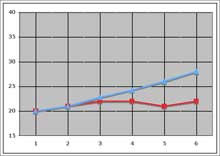
Laney graph: This graph shows Laney'due south information point graph and goal line graph. The x-axis is labeled "1 through 6" in ane-point intervals. The y-axis is labeled "15 through 40" in five-point intervals. Laney's data points are in ruddy and are as follows for weeks 1 through 6: 20, 22, 23, 23, 21, and 23. Laney'due south goal line stretches from 20 at week i to 28 at week 6. Laney's starting time three data points are around the goal line, merely her last three information points fall below the goal line.
Heed equally Doug and Lynn Fuchs hash out the characteristics that make special education unique and individualized.

Doug Fuchs, PhD
Nicholas Hobbs Endowed Chair
in Special Pedagogy and Human Development
Vanderbilt University, Nashville, TN
(time: 0:24)
View Transcript

Lynn Fuchs, PhD
Nicholas Hobbs Endowed Chair
in Special Education and Human being Development
Vanderbilt University, Nashville, TN
(time: 0:nineteen)
View Transcript
Transcript: Doug Fuchs, PhD
What should be "special" nigh special instruction is that information technology should be information-based, individualized, and recursive, significant that the special didactics teacher uses an experimental approach to make up one's mind what effective instruction is for each kid. It is non going to be known up front what the right curriculum is for this kid, what the right instructional approach is for this child.
Transcript: Lynn Fuchs, PhD
You accept progress monitoring data, and you exam the effectiveness of instructional components for a child. And yous comprise the ones that look constructive for that child, and you driblet other components that don't await constructive. So it'southward experimental for that child.

Source: https://iris.peabody.vanderbilt.edu/module/rti05/cresource/q2/p05/
0 Response to "What Key Instructional Principles Do Research-validated Reading Interventions Often Include?"
Postar um comentário